


SMC Insurance
Welcome to SMC.
How may I assist you?


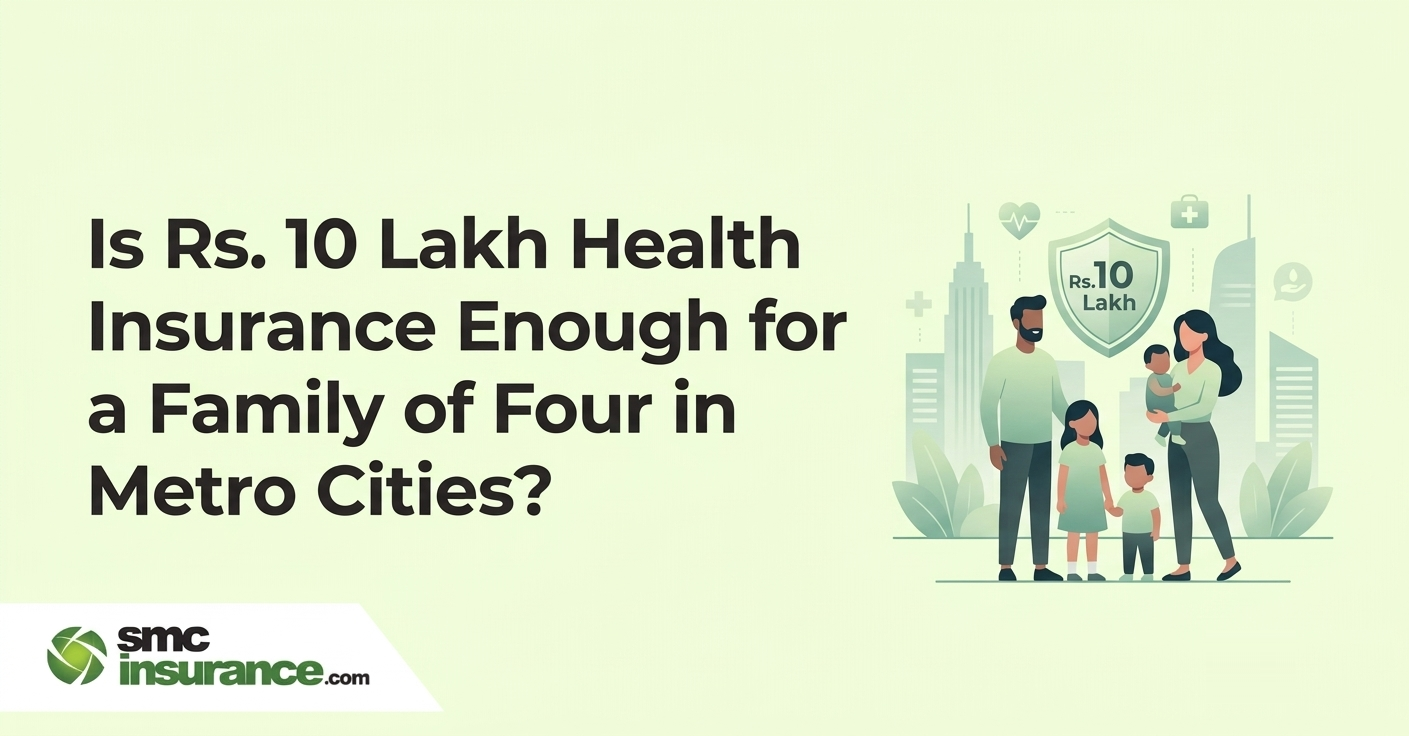
A Rs. 10 lakh health insurance cover is usually not enough for a family of four in metro cities. Rising healthcare costs, shared family floater coverage, and the risk of multiple hospitalisations can exhaust this amount quickly. Most insurers and financial planners suggest at least Rs. 20–25 lakh total coverage, often combining a base plan with a super top-up for better protection.
A hospital bill in a metro rarely feels real until it lands in your hand. A short ICU stay, a surgery, a few specialist visits and suddenly the number crosses Rs. 8-10 lakh. That is not a rare scenario anymore. A 2024 report by The Hindu highlighted how urban hospitalisation costs have risen sharply post-pandemic, with private hospitals in cities like Mumbai and Delhi charging 20-30% more than pre-2020 levels.
Here’s the uncomfortable gap: many families still rely on a Rs. 10 lakh health insurance cover, assuming it will be enough. For a family of four, that assumption can fall apart fast. By the end of this article, you will know whether Rs. 10 lakh truly protects your family, where it works and where it quietly falls short.
Start with a simple number. A single hospitalisation in a top-tier private hospital in a metro can cost anywhere between Rs. 3 lakh and Rs. 12 lakh depending on the treatment. Now stretch that across four people. Think of it this way: a family floater health insurance plan pools the sum insured across all members. So that Rs. 10 lakh is not per person. It is shared.
|
Treatment Type |
Average Cost in Metro Cities |
Best For |
|
Normal Delivery |
Rs. 80,000 – Rs. 1.5 lakh |
Young families |
|
Heart Surgery |
Rs. 4 lakh – Rs. 10 lakh |
Middle-aged policyholders |
|
Cancer Treatment (initial) |
Rs. 5 lakh – Rs. 12 lakh |
High-risk families |
|
ICU Stay (per day) |
Rs. 25,000 – Rs. 75,000 |
Emergency coverage planning |
Note: Costs vary by hospital, city and medical condition. Always check current estimates.
Here’s what most people miss: one serious illness can wipe out the entire Rs. 10 lakh cover in a single year. After that, you pay out of pocket.
A family floater health insurance policy sounds efficient. One premium, one shared cover. It works well when claims are rare. But metro living introduces a different pattern. More stress, lifestyle diseases, pollution exposure and longer life expectancy. That raises the odds of multiple claims within a single year.
Think if your child needs surgery costing Rs. 3 lakh. Later the same year, a parent requires a cardiac procedure worth Rs. 7 lakh. Your Rs. 10 lakh cover is gone. Now ask yourself: “What happens if a second major illness hits?”
Important Note: A family floater health insurance plan is cost-effective, but the risk concentration is higher. One or two large claims can exhaust the entire cover quickly.
The numbers tell a different story. Medical inflation in India hovers around 12-14% annually, according to IRDAI-backed industry estimates. Salaries do not grow at that pace for most households. That gap compounds over time.
A procedure costing Rs. 5 lakh today could cost Rs. 9-10 lakh in seven years. If your cover stays fixed at Rs. 10 lakh, its real value shrinks every year. There is also a quiet irony here. Healthcare is improving, survival rates are rising, yet treatment costs are climbing even faster. That makes underinsurance more dangerous than no insurance at all.
As per IRDAI guidelines, the maximum waiting period for pre-existing diseases in health insurance policies is capped at 36 months, after which coverage must be provided if the policy is continuously renewed.
Mint reports that medical inflation in India is among the highest in Asia, meaning a Rs. 10 lakh cover today may fall short much faster than families expect. Here’s the pattern:
So the real question is not whether Rs. 10 lakh helps, it does. The real question is whether it protects fully. Here, the answer is “not quite”.
There is no single number that fits everyone, but metro families need a higher baseline. For a family of four in cities like Chennai, Mumbai, or Delhi:
This keeps premiums manageable while expanding coverage significantly.
Quick Tip: A super top-up kicks in after your base cover is exhausted. It is cheaper than buying a high base policy and works well for rare but expensive claims.
Note: IRDAI has removed the upper age limit for purchasing health insurance, allowing individuals to buy policies at any age.
Premium differences are often smaller than people expect.
|
Coverage Type |
Annual Premium (Approx) |
Best For |
|
Rs. 10 lakh family floater |
Rs. 12,000 – Rs. 18,000 |
Young families, low risk |
|
Rs. 20 lakh family floater |
Rs. 18,000 – Rs. 28,000 |
Urban middle-income households |
|
Rs. 10 lakh + Rs. 25 lakh super top-up |
Rs. 16,000 – Rs. 24,000 |
Balanced cost and high coverage |
Note: Premiums vary by age, insurer and medical history.
That extra Rs. 5,000-Rs. 8,000 a year can double or triple your protection. Still comparing options? A good health insurance platform lets you check premiums, add top-ups and compare plans without paperwork or calls. It takes a few minutes and saves long-term stress.
Getting the right cover is a process. Here’s how to do it:
Lower premium plans often come with restrictions. Room rent caps, disease-specific limits and co-pay clauses can reduce the actual payout. You may have Rs. 10 lakh on paper but receive less during claims.
The Catch: A room rent cap can trigger proportional deductions across the entire bill. Choosing a slightly higher premium plan without caps often saves more during claims.
It works as a starting point but it does not work as a complete shield in metro cities. A single major illness can exhaust it. Two events in one year almost certainly will. If your budget is tight, begin with Rs. 10 lakh. But build on it quickly with a top-up. If you already have Rs. 10 lakh, review it this year. Costs are rising faster than most expect.
But always remember IRDAI does not mandate a minimum or ideal sum insured; choosing adequate coverage depends on individual needs, location, and medical cost trends.
Rs. 10 lakh health insurance offers basic protection, not full security, for a metro family of four. Rising medical costs, shared coverage and multiple claim risks make it insufficient on its own.
Disclaimer:The information provided on this platform is intended for general awareness and educational purposes. While every effort is made to ensure accuracy, some details may change with policy updates, regulatory revisions, or insurer-specific modifications. Readers should verify current terms and conditions directly with relevant insurers or through professional consultation before making any decision.
All views and analyses presented are based on publicly available data, internal research, and other sources considered reliable at the time of writing. These do not constitute professional advice, recommendations, or guarantees of any product’s performance. Readers are encouraged to assess the information independently and seek qualified guidance suited to their individual requirements. Customers are advised to review official sales brochures, policy documents, and disclosures before proceeding with any purchase or commitment.
It can cover minor to moderate treatments. For metro cities, it often falls short for major illnesses or multiple claims in a year.
Most experts suggest Rs. 20-25 lakh combined coverage, especially in urban areas with high medical costs.
It is cheaper and simpler. But the shared sum insured can be a limitation if multiple members need treatment.
It is an additional policy that activates after your base cover is exhausted. It helps increase total coverage at a lower premium.
Premiums typically range from Rs. 12,000 to Rs. 18,000 annually, depending on age, city and health profile.
Yes, insurers allow upgrades. But higher age or existing conditions can increase premiums or add restrictions.


SMC Insurance Brokers Pvt. Ltd.
SMC Metro Mall, Near Pratap Nagar Metro Station, Pratap Nagar, New Delhi-110007
Registration No: 289, Registration Code No: IRDAI/DB-272/04/289, Valid till: 27/01/2029, License category: Composite Broker, CIN: U66000DL1995PTC172311
Insurance is the subject matter of solicitation.
Visitors are hereby informed that their information submitted on the website may be shared with insurers.
Product information is authentic and solely based on the information received from the Insurer.
