


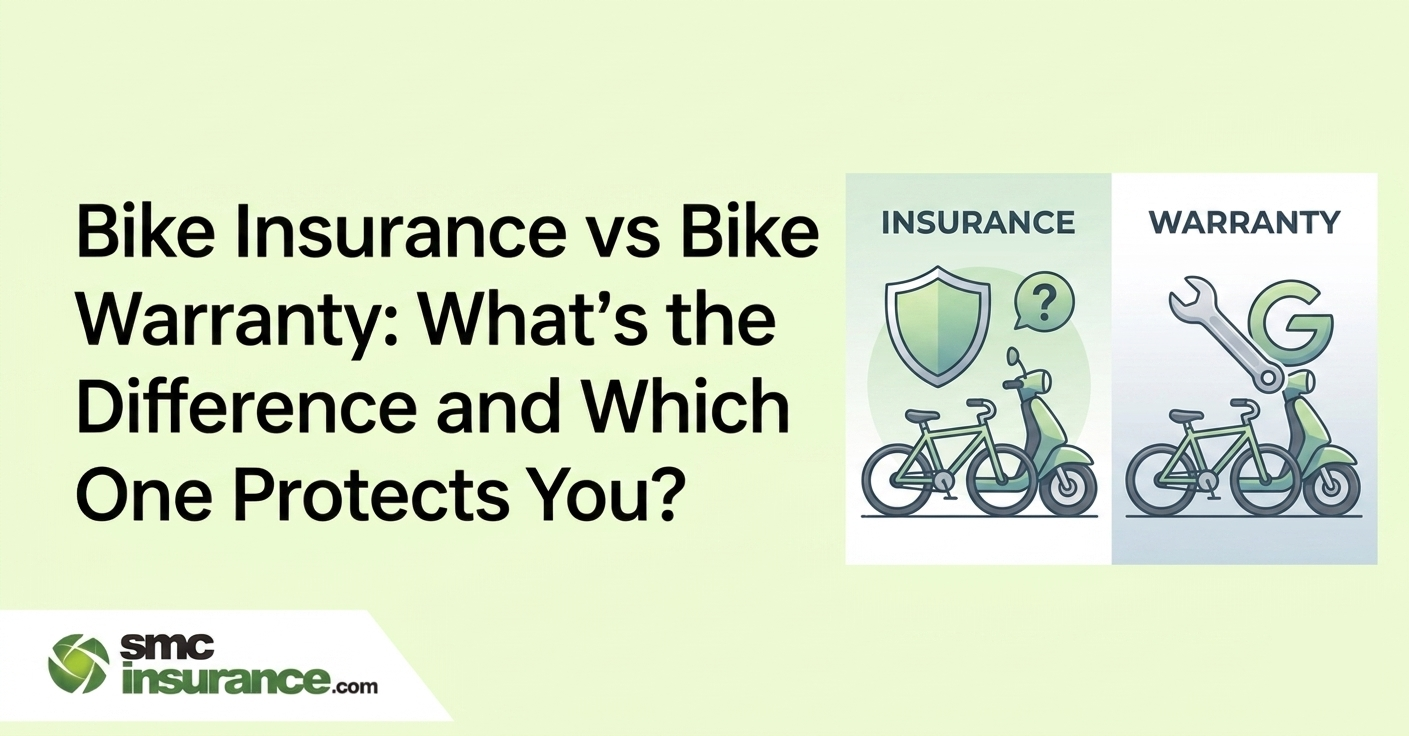
Bike insurance and bike warranty are not the same thing. A bike warranty (offered by the manufacturer) covers manufacturing defects in parts like the engine, gearbox and electrical components. This is typically for 5 years or a fixed mileage limit.
Bike insurance (regulated by IRDAI) covers accidents, theft, natural disasters and third-party legal liability. Third-party bike insurance is mandatory by law in India; violation carries a Rs. 2,000 fine.
For full protection, you need both: the warranty protects against what the factory got wrong; comprehensive bike insurance protects against everything the road can do to your bike.
You just bought a new bike. The dealer hands you two sets of documents — one from the manufacturer, one from the insurance company. Both claim to "protect" your vehicle. Most riders sign everything without a second thought, assuming the two documents do roughly the same job. They don't.
A friend's Splendor Plus threw a faulty CDI unit three months after purchase. The warranty covered it at zero cost. A week later, a pothole accident cracked the front fork. The warranty was useless. His bike insurance stepped in. Two separate problems, two completely different solutions. That's the gap most riders only discover the hard way.
This article breaks down exactly what bike insurance covers, what a bike warranty covers, where they overlap (almost nowhere) and what you need to do to make sure you're not left paying out of pocket for something you assumed was already covered.
What Exactly Is a Bike Warranty? What Does It Actually Cover?
A bike warranty is a written commitment from the manufacturer (not an insurer) that certain parts will be repaired or replaced free of charge if they fail due to a manufacturing defect within a defined time or mileage limit. You don't pay a premium for it. It comes bundled with the purchase price of the vehicle.
The key phrase is "manufacturing defect." That's the warranty's entire universe. If the engine casting has a flaw, if the electrical ignition coil fails without any external cause, if the gearbox malfunctions under normal use, the warranty applies. If you caused it, crashed it, or wore it out through use, it doesn't.
Warranty Periods Across Major Indian Manufacturers
India's top two-wheeler manufacturers offer some of the most competitive warranty terms globally:
|
Manufacturer |
Standard Warranty |
Mileage Cap |
Extended Warranty Available? |
|
Hero MotoCorp |
5 years |
70,000 km (motorcycles) / 50,000 km (scooters) |
Yes |
|
Bajaj Auto |
5 years |
75,000 km |
Yes |
|
Honda Motorcycle & Scooter India |
Varies by model |
Up to 1,30,000 km (Extended Warranty Plus) |
Yes — up to 10 years |
|
TVS Motor |
Typically 2–3 years |
Varies by model |
Yes |
|
Royal Enfield |
2 years |
Standard |
Yes |
Note: Warranty terms are subject to change. Always verify with the official dealer at the time of purchase.
The warranty becomes void the moment either the time limit or the mileage cap is crossed, whichever comes first.
Recent Regulatory and Policy Developments (2025–2026)
- IRDAI continues to standardise policy structures and improve claim servicing timelines under its policyholder protection framework
- Long-term policies (5-year TP + bundled OD) remain standard for new vehicles
- Standalone Own Damage (OD) policies are allowed for vehicles already covered under long-term TP insurance
- Insurers are being pushed to expand motor third-party coverage across India
What the Warranty Covers and What It Doesn't
The warranty covers mechanical failures (engine, gearbox), electrical component defects (CDI unit, ignition coil, ABS module if applicable) and safety system faults, etc., all due to factory defects. Labour charges may or may not be included depending on the brand.
It does not cover:
- Accident damage of any kind
- Tyres, brake pads and consumables (engine oil, nuts, bolts, rubber gaskets)
- Wear and tear from normal use
- Damage from modifications or alterations
- Components serviced outside authorised centres
- Mechanical or electrical breakdown not caused by an accident is not covered under bike insurance
- Any damage from illegal racing, negligent handling, or flood exposure
One more condition that catches many owners off-guard: the warranty is almost always conditional on servicing your vehicle only at authorised service centres, as per the manufacturer's recommended schedule. Miss a service interval, get your bike serviced at a local mechanic and manufacturers may reject warranty claims if service schedules are not followed or if non-authorised servicing is found to have contributed to the issue.
What Bike Insurance Actually Does and Why It's Non-Negotiable
Bike insurance is a financial product regulated by the Insurance Regulatory and Development Authority of India (IRDAI). It protects you against external risks: accidents, theft, natural disasters and legal liability to others. Unlike a warranty, it is purchased annually (or for a defined term), involves a premium payment and its terms are governed by both the insurer and IRDAI guidelines.
Under the Motor Vehicles Act, 1988, carrying a valid third-party (TP) bike insurance is mandatory for every two-wheeler on Indian roads. Riding without it attracts a fine of Rs. 2,000 for the first offence and Rs. 4,000 for subsequent offences and/or imprisonment of up to 3 months.
Types of Bike Insurance in India
Third-Party (TP) Insurance
TP insurance is mandatory by law. Covers injury, death, or property damage caused to a third party by your vehicle. Does not cover damage to your own bike. IRDAI regulates and notifies third-party premium rates, which insurers must follow.
Own Damage (OD) Cover
OD cover is optional. It covers damage to your own vehicle from accidents, fire, theft, floods and more. Premiums vary by insurer, IDV (Insured Declared Value) and NCB (No Claim Bonus).
Comprehensive Bike Insurance
This combines TP and OD in a single policy. Recommended for most riders, especially those with bikes less than 5 years old.
Personal Accident (PA) Cover
Personal Accident (PA) cover of Rs. 15 lakh for the owner-driver is mandatory if the individual does not already have an active PA cover under another motor insurance policy
IRDAI-Regulated Third-Party Premium Rates (Annual, FY 2024–25)
|
Engine Capacity |
Annual TP Premium |
|
Up to 75cc |
Rs. 538 |
|
75cc to 150cc |
Rs. 714 |
|
150cc to 350cc |
Rs. 1,366 |
|
Above 350cc |
Rs. 2,804 |
Note: These are IRDAI-regulated rates, uniform across all general insurers. New bike owners must purchase a 5-year third-party policy, mandated following directions from the Supreme Court and implemented through IRDAI guidelines requiring long-term third-party policies for new two-wheelers . OD and comprehensive premiums vary by insurer. Source: IRDAI/MoRTH notifications.
The own-damage premium depends on factors like the bike's IDV, your city, the insurer and your NCB (a discount of up to 50% for claim-free years).
Bike Insurance vs Bike Warranty
These two products address entirely different risks. The confusion arises because both involve repairs and both involve the bike. Beyond that, they share almost nothing.
|
Situation |
Bike Insurance (Comprehensive) |
Bike Warranty |
|
Accident damage to your bike |
Covered |
Not covered |
|
Third-party injury or property damage |
Covered |
Not covered |
|
Engine fails due to manufacturing defect |
Not covered |
Covered |
|
Bike stolen |
Covered |
Not covered |
|
Flood or natural disaster damage |
Covered |
Not covered |
|
Faulty electrical component (CDI, ignition coil) |
Not covered |
Covered (within warranty period) |
|
Tyre burst or brake pad failure |
Not covered |
Not covered |
|
Wear and tear |
Not covered |
Not covered |
|
Personal accident for rider |
Covered (PA cover) |
Not covered |
|
Total loss of vehicle |
Covered |
Not covered |
|
Is it mandatory? |
TP is mandatory by law |
Automatic with new purchase |
|
Who provides it? |
IRDAI-regulated insurer |
Vehicle manufacturer |
|
Renewal required? |
Yes, annually |
No (it expires automatically) |
Note: Coverage details for insurance vary by policy type (TP only vs. comprehensive) and add-ons chosen. Always read the policy document carefully.
The practical takeaway: if you crashed your bike today, your warranty is irrelevant. If your brand-new engine throws a defect at 2,000 km, your insurance won't help you.
Not Sure Which Coverage You're Missing Right Now?
Many riders hold only basic third-party insurance - legally compliant but financially exposed. A single accident can run into tens of thousands of rupees depending on the bike model and extent of damage, with no OD cover. And once the warranty expires, those repair bills are entirely out of pocket.
Visit SMC Insurance to compare comprehensive bike insurance plans, check if your current policy covers own damage and get expert guidance on the right add-ons for your bike and riding pattern.
The Extended Warranty Question: Is It Worth Buying?
Once your standard warranty ends, manufacturers offer an extended warranty. It is essentially a paid extension of the factory warranty. It's not insurance. It still only covers manufacturing defects, not accidents or theft. An extended warranty makes sense if:
- You plan to keep the bike for 7+ years
- The bike model has had known reliability issues
- You ride extensively and hit mileage caps quickly
It makes less sense if:
- You change bikes every 3–4 years
- The bike is already past its 5-year mark (limited residual value)
- The extended warranty has too many service-centre conditions
One thing to watch: extended warranties often require you to continue servicing exclusively at authorised centres. For riders in smaller towns with limited authorised service access, this can be a practical constraint.
How to Check and Maintain Your Bike Warranty?
Many owners don't know if their warranty is still active, especially when buying a used bike or after a gap in servicing.
Step 1 — Check your Owner's Manual or warranty booklet for the issue date and applicable conditions.
Step 2 — Visit the manufacturer's official website or contact their customer support line. Most brands (Hero, Bajaj, Honda) allow warranty status checks through your chassis number (VIN).
Step 3 — If buying a used bike, confirm the warranty transfer eligibility directly with the manufacturer. Many standard warranties are non-transferable.
Step 4 — Maintain a service record. Every gap in authorised servicing is a potential ground for warranty claim rejection. Keep service receipts.
One important rule: never get repairs or modifications done at a non-authorised workshop if the vehicle is under warranty, even for minor work. It hands the manufacturer a reason to void coverage on a future claim.
Why Do You Need Both — Not One or the Other?
A bike warranty handles what the manufacturer got wrong. Bike insurance handles what the road throws at you. These are not competing products. They are complementary, covering completely non-overlapping risks.
Riding only on a warranty with third-party insurance is like carrying a fire extinguisher but no helmet. You're protected against one very specific thing. For everything else (a collision, a stolen bike, a flood) you're paying from your own pocket.
The smarter approach is straightforward: maintain the factory warranty by sticking to authorised service schedules and hold a comprehensive bike insurance policy with at minimum an OD cover. For bikes ridden in high-traffic cities or flood-prone areas, add zero-depreciation and engine protection covers.
Must-Read Guides From SMC
Wrapping Up,
Bike insurance and bike warranty both protect your vehicle, but they operate in completely separate domains. A warranty is a quality guarantee from the manufacturer and it pays for factory errors, nothing more. Bike insurance is a financial safety net for the real world: accidents, theft, natural disasters and legal liability.
In India, third-party bike insurance is legally mandatory from day one. The warranty comes automatically with every new purchase. What most riders neglect is the own-damage cover - the part of comprehensive insurance that actually pays for repairs to your own bike after an accident.
Your warranty will expire. Your bike won't stop needing protection. Renew your insurance on time, keep your service records clean and evaluate extended warranty terms honestly before you sign. That's how you stay covered.
Disclaimer:The information provided on this platform is intended for general awareness and educational purposes. While every effort is made to ensure accuracy, some details may change with policy updates, regulatory revisions, or insurer-specific modifications. Readers should verify current terms and conditions directly with relevant insurers or through professional consultation before making any decision.
All views and analyses presented are based on publicly available data, internal research, and other sources considered reliable at the time of writing. These do not constitute professional advice, recommendations, or guarantees of any product’s performance. Readers are encouraged to assess the information independently and seek qualified guidance suited to their individual requirements. Customers are advised to review official sales brochures, policy documents, and disclosures before proceeding with any purchase or commitment.
FAQs
Bike insurance is a financial product regulated by IRDAI that protects you from external risks like accidents, theft, natural disasters and third-party liability. A bike warranty is a manufacturer's commitment to repair or replace parts that fail due to a manufacturing defect within a fixed time or mileage limit. The critical distinction: insurance covers real-world damage from outside forces; warranty covers factory-level product failures. Riding with only a warranty and no insurance means you have zero financial protection the moment your bike gets into an accident or is stolen.
Yes, under the Motor Vehicles Act, 1988, third-party bike insurance is a legal requirement for every two-wheeler, irrespective of warranty status. Riding without it invites a Rs. 2,000 fine and possible imprisonment of up to 3 months. A warranty is a manufacturer's product quality commitment and it has no bearing on your legal obligation to carry insurance. The two are independent requirements.
No, a warranty applies only to manufacturing defects — parts that failed due to flaws in material or workmanship. Accident damage results from an external event, not a production fault, so it falls entirely outside warranty coverage. For accident-related repair costs to your own vehicle, you need own-damage cover under a comprehensive bike insurance policy.
Third-party bike insurance premiums are set by IRDAI and are uniform across all insurers. For FY 2024–25, the annual premium ranges from Rs. 538 for bikes up to 75cc, Rs. 714 for 75–150cc, Rs. 1,366 for 150–350cc and Rs. 2,804 for above 350cc. New bikes must have a 5-year third-party policy at purchase, per the Supreme Court directive. Own-damage and comprehensive premiums vary by insurer, bike IDV and your no-claim bonus history.
Yes, you can buy bike insurance online through insurer websites or authorised aggregators. You typically need your bike's registration certificate (RC), previous policy details (for renewals), chassis and engine number and your driving licence. For new bikes, the dealer typically assists with the first policy. Renewals can be done entirely online in a few minutes.
Getting your bike serviced outside an authorised service centre is one of the most common and costliest warranty mistakes. Most manufacturers, including Hero MotoCorp and Bajaj, explicitly state that warranty benefits are conditional on following the prescribed service schedule at authorised workshops. Servicing at a non-authorised garage can give the manufacturer valid grounds to reject your warranty claim, even if the component failure has nothing to do with the servicing.
An extended warranty is worth considering if you plan to keep the bike for 7 or more years and have easy access to authorised service centres. Honda's Extended Warranty Plus, for instance, covers up to 10 years or 1,30,000 km. However, it still only covers manufacturing defects. Evaluate the cost versus the likelihood of needing a major factory-defect repair in years 5–10 of ownership. If your bike is a reliable commuter model with a strong service network nearby, an extended warranty can offer meaningful peace of mind at a modest cost.


